Live Rates

Tuesday, 12 April 2016

Islamic Swap Free Account

             
OPEN LIVE ACCOUNT


OPEN YOUR PORTFOLIO MANAGEMENT ACCOUNT NOW,
 LET THE CYSEC LICENCED EXPERTS TRADE FOR YOU.
In Forex, there is the payment of swaps every day; this is the interest rate of a currency that the currency earns per day. This interest for a currency like theAustralian Dollar is 5%, this means that every day a fraction of this five percent is paid to anyone holding this Australian Dollar.

This brings the Issue of paying and getting paid interest which is an Issue in Islamic Religion. Islamic Religion does not allow paying and getting paid interest, For Islamic currency traders there is an account designed in accordance with their Values; Known as Swap Free.

For this account a trader will not pay the overnight rollover interest on any currency and will also net get paid any interest, this is also known Shariah Compliant where there is no paying of RIBA (interest) - also referred to as Islamic Accounts.

For a trader to get a swap free account, a trader has to go to a broker and select the option of “Islamic Account”, This option is provided under the Accounts Section of the currency broker specifying the instructions of opening one of these accounts.

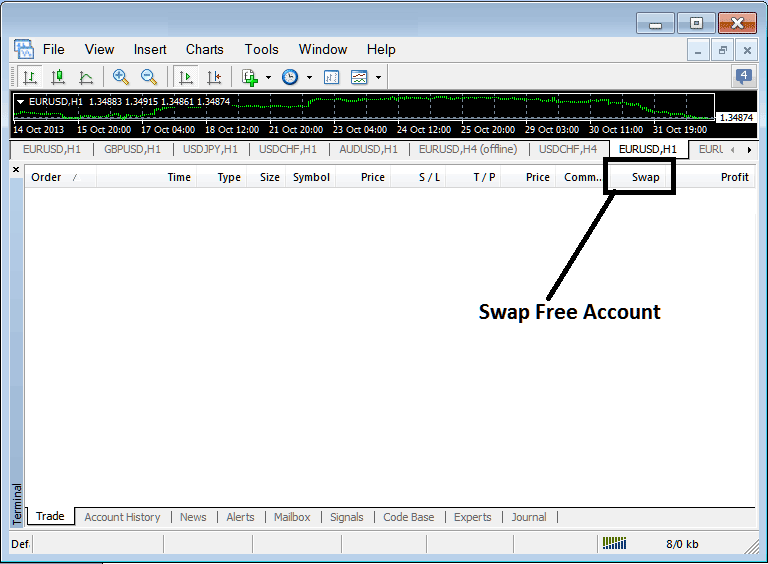
Once a trader opens this account, then the Forex rollover interest is removed. Once this no paying of interests is set, if a trader is using a trading platform such as the MetaTrader 4 then the rollover fee record will be set to zero.
The rollover fee is charged daily at the end of the trading day for those holding a particular currency for which a swap is to be applied. As a trader if you do not want to pay this  rollover you should close your trades before the end of the day, that way you will not pay the rollover fee as you are no longer holding the currencies. Because the currency market does not open on Saturday and Sunday, the rollover for this 2 day will be charged on Wednesdays, meaning on Wednesday one will pay the rollover for Wednesday, Saturday, and Sunday, and therefore on Wednesdays this rollover fee is paid 3 Times.

These positions that pay a rollover interest are commonly referred to by traders as Overnight Positions. Day Traders rarely leave their trades opened overnight and close them all before the end of the day. Swing Traders, on the other hand, may leave their trades opened for a few days and leave these trades overnight so as to capture more movement in the price trend.

Once a trader finds a swap free Forex broker and opens and Islamic Account, the trader will have the same trading conditions as those of other traders, except for the paying of rollover fees. This means a trader will use the MetaTrader 4 Platform like all the other traders, the trader can trade all currencies, all indices, all CFDs, all metals and all other Financial Instruments provided by the broker.

However, be careful in selecting a swap free broker, some brokers will add a commission or add some pips to the spread you trade with to cover the swap(Swap Fee Broker). This is not supposed to happen as the trader will still be paying for the interest even though is disguised as another charge, good Brokers do not add any commission nor do they add any charge on to the spreads.

Another thing is that some brokers will charge a rollover fee if the position held by a trader is held for more than 5 days or more than 7 days, this should not be the case and the broker should not charge any carry over interest even if the open positions are held for more than five or seven days. For traders wanting to open this swap free Account it is good to check for any additional terms of trading for the Islamic Account that you are going to be opening to make sure that the broker you choose is really a
no swap broker.
                             Islamic Investment Forex Trading Account - Swap Free Account
                            OPEN YOUR PORTFOLIO MANAGEMENT ACCOUNT NOW 

Wednesday, 6 April 2016

FOMC Minutes to Validate Fed and Markets on US Rate Hikes

Stop trying luck, FX trading is an emotional Sport driven by skills.

                                                                      Learn it.   
----------------------------------------------------------------------------------------------------------------------------------
After hiking at the end of 2015 the Fed has now lowered Expectations to 2 Raises in 2016
The USD recorded the worst quarterly performance since 2010 as Fedspeak and Fedfacts have clashed. The March Federal Open Market Committee (FOMC) disappointed with its dovish tone, specially after the European Central Bank (ECB) had gone all out on its quantitative easing (QE) push earlier in the month. Fed member hawkish remarks reversed the USD down trend, only to be brought down to earth after Fed Chair Yellen’s speech at Economic Club of New York.
The release of the March FOMC minutes could put further downward pressure on the USD when they are published on Wednesday, April 6 at 2:00 pm EDT. Comments from Federal Reserve Bank of Kansas City President Esther L. George will be actively searched as she was the only dissenter on the vote to hold interest rates unchanged.
Fed facts and official statements have stressed the caution with which the central bank will approach the decision to raise rates in the future. That patient stance has made the market punish the USD versus other pairs as it is unlikely there will be more than 2 rate hikes in 2016, when at the end of 2015 the expectation backed by Fed forecasts was double that.

The EUR/USD had a 0.10 percent loss in the last 24 hours. The USD advanced slightly ahead of the release of the March Federal Open Market Committee (FOMC) meeting minutes. The USD has been able to gain as investors looks for safety and close long positions ahead of the uncertain comments from Fed members on the U.S. economy and the effects of a global slowdown are having on growth.
Commodity currencies were hit by the risk off move combined with the uncertainty surrounding the energy market. The Doha summit has been mostly a source of stability for the volatile price of energy, but comments from Organization of the Petroleum Exporting Countries (OPEC) and non-OPEC nations has raised doubts about the oil output freeze agreement to be signed on April 17. Saudi Arabia and Iran continue at the heart of the disagreement.

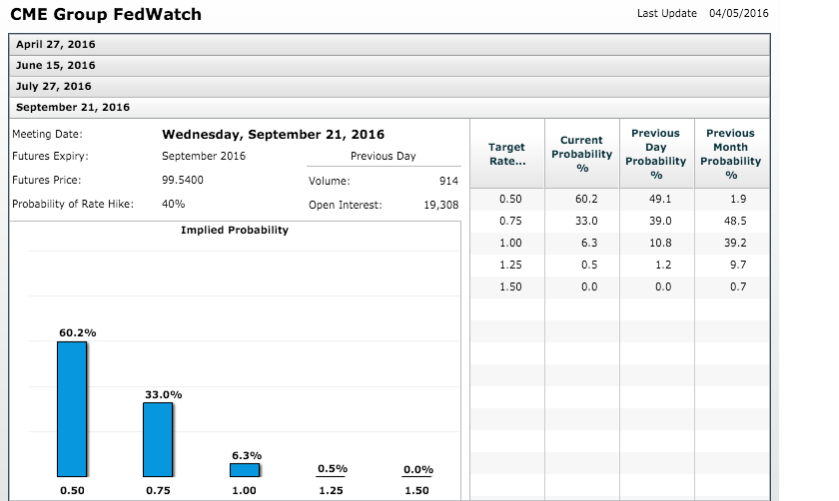
The CME Fed Watch Tool is showing that the market and the Fed agree on a limited rate hike outlook. The September FOMC is a likely candidate for a rate hike with 40 percent of a rate hike. June and December are also in the running as they feature a press conference following the publication of the Fed Funds rate statement.
Countdown to FOMC - CME Group
The CME Fed Watch tool has a 18 percent for June and 57 percent for December. Going by past Fed behaviour June is probably too early and the central bank would be acting with a limited data set. The main challenge with September is the proximity of the November U.S. presidential election and the risk of a rate hike seen as biased to a particular candidate. December then becomes the most probably choice, but remains to be seen if the U.S. economy will be ready by then, so far the Fed can afford to be patient and has said through its member’s statements that it could let inflation run hot before raising rates.
USD events to watch this week:
Wednesday, April 6
10:30am USD Crude Oil Inventories
2:00pm USD FOMC Meeting Minutes
Thursday, April 7
8:30am USD Unemployment Claims
Tentative EUR ECB President Draghi Speaks
5:30pm USD Fed Chair Yellen Speaks
Friday, April 8
4:30am GBP Manufacturing Production m/m
8:30am CAD Employment Change
8:30am CAD Unemployment Rate
*All times EDT
Happy Trading.


Monday, 4 April 2016

Ego and Success

                                                     
 OPEN LIVE ACCOUNT

CYSEC Licensed Portfolio Managers Ready to serve Nigerians

                            Stop trying luck, FX trading is an emotional Sport driven by skills.                      

Email us @admin@emalbansfx.com for details.


When entering a trade, a trader is always optimistic, certain that the market will prove them right and there is no doubt in their mind that their analysis is correct.
If or when the market turns against them, a trader’s ego can be a dangerous weakness.  You see, the market can move in a direction opposite to a trader’s prediction for a lot longer than a trader can remain solvent (or sane) and a trader with a high ego may continue to think he is right about his analysis even when the market persists to travel in a direction opposite to the trader’s prediction.
How do you fight your trader’s optimism?
Know upfront that even successful traders can be profitable when only correct about maybe 50% of their trades, so when planning a trade, think of the worst case scenario, and set your Stop Loss levels with a pessimistic outlook in mind.
Learn that successful traders profit from not limiting their upside risk, rather than their downside risk. This means that great investors know to cut their losses short and do not get anxious when winning, looking to cash their profits early.
Having a thorough risk management plan is crucial to a successful trading strategy and planning with the knowledge that you won’t always be right, no matter how much you think you will be, can help you react correctly when you experience a loss. Keeping your ego under control can help you achieve overall trading success. 
Happy Trading. 
   

7 Major Event for the week 4th to 8th April, 2016.

 OPEN LIVE ACCOUNT

CYSEC Licensed Portfolio Managers Ready to serve Nigerians Stop trying luck, FX trading is an emotional Sport driven by skills.                      Email us @ admin@emalbansfx.com for details.


The US dollar was hit hard by Yelle’s dovish tone and the recovery was limited. Yellen has another opportunity to move the greenback in the upcoming week. In addition, a rate decision in Australia, the US Non-Manufacturing PMI and the FOMC meeting minutes stand out. These are the highlights of this week. Here is an outlook on the coming financial events.
The Non-Farm Payrolls report showed US economy gained 215,000 jobs in March, reaffirming the strength of the labor market, despite recent economic headwinds. The reading was higher than the 206,000 forecast but not enough to maintain February’s low unemployment rate which increased to 5.0%. Nevertheless average hourly earnings edged up 7% representing a 2.3 percent annualized again. The retail sector showed the biggest increase with 48,000 new jobs, while construction and health care added 37,000 each. The report was very good but it is unlikely that it would change the Fed’s decision to postpone its rate hike plans. Let’s start,
Updates:
    1. Australian rate decision: Tuesday, 1:30. The Reserve Bank of Australia kept its cash unchanged at 2% in March, but hinted it may cut rates in the near future. Governor Glenn Stevens reiterated the downside risks in low inflation noting it may induce the RBA to cut rates. The Employment market also concerns the central bank after a surprise jump in the unemployment rate. Furthermore, global market uncertainty raises fears of future growth. Economists expect the RBA will cut interest rates to 1.5% this year.
    2. US ISM Non-Manufacturing PMI: Tuesday, 14:00. The U.S. service sector expanded in February reaching 53.4 a bit lower than the 53.5 posted in the previous month. The reading was higher than the 53.2 figure expected by analysts. Business activity index increased to 57.8 from 53.9 the month before. Employment index fell to 49.7 from 52.1 a month earlier, showing the first decline since February 2014. New orders dropped to 55.5 from 56.5. The prices paid index fell to 45.5 from 46.4.  US service sector is expected to expand further to 54.1 in March.
    3. US Crude Oil Inventories: Wednesday, 14:30. U.S. crude inventories increased 2.3 million barrels in the last week, falling short of the 3.3 million-barrel gain forecasted by analysts. Oil prices were boosted by the weak dollar becoming more attractive to users of the euro and other currencies. OPEC oil output increased in March, amid higher supply from Iran.
    4. US FOMC Meeting Minutes: Wednesday, 18:00. The FOMC minutes from the Fed’s January meeting showed the main topic of concern was the continuing deterioration of global financial and their downside risks to the U.S. economy. On the opposite side, some” members noted that wage pressures had increased. Overall the minutes indicate that an easing in global volatility, together with continued improvement in the domestic labor market and inflation, could bring another rate hike in the following months.
    5. US Unemployment Claims: Thursday, 12:30. The number of new claims for unemployment  aid edged up unexpectedly  last week, but remained below the 300,000 line indicating strong employment market. Claims increased 11,000 to a seasonally adjusted 276,000, higher than the 267,000 forecast. The four-week moving average of claims increased by 3,500 to 263,250 last week. Economists expect nonfarm payrolls to increase 205,000 this month following a 242,000 gain in February. The unemployment rate is expected to remain unchanged at 4.9%. Economists expect 271,000 increase in the number of claims this week.
    6. Janet Yellen speaks: Thursday, 21:30. Fed Chair Janet Yellen will speak in New York at the International House. She may talk about the recent positive employment data and the resilient consumer spending and may also refer to her pessimistic views on Global economy and its downside risks to the US economy. Market volatility is expected.
    7. Canadian employment data: Friday, 12:30. Canada’s employment market contracted unexpectedly in February losing 2,300 jobs raising jobless rate to 7.3%. The unemployment rate climbed to the highest level since March 2013 surprising analysts who had forecast Canada would add almost 10,200 jobs. Most of the job cuts were full-time, losing 52,000 jobs during the month. That figure was partially offset by an increase in part-time work.
    That’s it for the major events this week. *All times are GMT.
    By; ANAT DROR.
     OPEN LIVE ACCOUNT

    Sunday, 3 April 2016

    Pounds may be positive soon.

                                                                             
     OPEN LIVE ACCOUNT
                                      
                                          CYSEC Licensed Portfolio Managers Ready to serve Nigerians

             Stop trying luck, FX trading is an emotional Sport driven by skills. 
                         Email us @ admin@emalbansfx.com for details.

    The Non-Farm Payroll numbers reported on Friday showed a growth of 215,000 workers over the last month following a gain of 245,000 in February. The report also showed that the economy was improving slowly and was pulling many Americans into the workforce albeit at part-time jobs. A separate poll of households showed the jobless rate ticked up to 5 percent from 4.9 percent as people streamed into the labor force looking for work, and not all were successful. Average hourly earnings gained seven cents after slipping in February.
    The labor market seems to have moved past key factors contributing to a slowing global economic growth. The robust U.S. dollar that has hurt manufacturing exports and pressure on energy sector profits from cheap oil have also not succeeded in keeping Americans away from entering the job market.
    According to Millan Mulraine, deputy chief economist at TD Securities in New York, “This is an ideal situation for the Fed. The strong pace of job growth is being offset by the increase in entrants into the labor force, which will reduce any concerns about labor market tightness fostering outsized wage inflation."

    GBP/USD Rebound Expected

    Fed Chair Janet Yellen’s dovish outlook for monetary policy hinted at in her speech last week has reached across the Channel and data out this week should suggest that the British Pound will continue to consolidate ahead of the next Bank of England (BoE) interest rate decision on April 14 and may generate a near-term rebound in.
    An increase in the U.K. Purchasing Manager Indices due out this week may boost the allure of the sterling and focus on an improved outlook for the region following the unexpected upward revision in the 4Q Gross Domestic Product (GDP) report. The economy posted an annualized 2.1% rate of growth during the last three-months of 2015 possibly prompting the BoE to adopt a more hawkish tone over the coming months as the central bank remains adamant that the next move will be to normalize monetary policy.
    And despite the Monetary Policy Committee (MPC) ‘s expected retention of its current policy ahead of the U.K. Referendum in June, positive data may generate a near-term rebound in the sterling as it boosts interest rate expectations.
    Daily Fx.
                              
     OPEN LIVE ACCOUNT